

The structure of a capacitor microphone.
2025-04-14
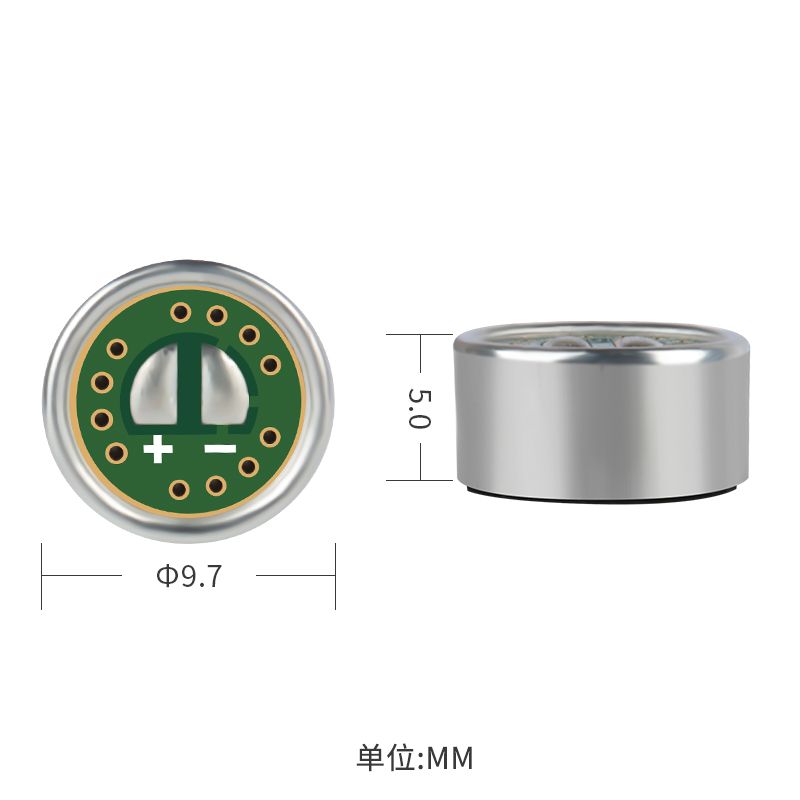
A condenser microphone primarily utilizes sound waves acting on a metal diaphragm. The diaphragm vibrates, altering the distance between it and a fixed backplate, thus changing the capacitance. Sound is picked up by obtaining the electrostatic charge variation between the diaphragm and backplate via a load resistor.
In other words, by applying a 100-200V DC bias (polarizing voltage) between the diaphragm and backplate of the condenser microphone, it can begin to pick up sound.
If the sound is loud, the diaphragm's vibration amplitude is large, resulting in a large output voltage amplitude. If the sound's pitch is high, the diaphragm's vibration frequency is high, and the output voltage's frequency of change is also high. If the sound's timbre is different, the diaphragm's vibration pattern (waveform) is different, and the output voltage also has corresponding waveform changes. Below is an outline of the working principle of a condenser microphone:

After connecting a battery to parallel conductors, the positive and negative charges of the condenser microphone will be relatively evenly distributed, allowing charging on the parallel conductors. If one of the positive and negative poles of the condenser microphone is fixed, and sound pressure is applied to the other, changing the distance, the electrostatic capacitance will change. Once the electrostatic capacitance of the condenser microphone changes, the amount of charge will also change. Connecting a resistor to the output terminal of the condenser microphone will also produce corresponding voltage changes. This is the working principle of a condenser microphone.
Because condenser microphones have certain advantages in frequency response, sensitivity, inherent noise, and distortion, they have been a hot topic in the field of acoustic research.
Initially, research on condenser microphones (transducers) was primarily led by European countries such as the Netherlands, Switzerland, and Germany. Later, developed countries in Europe and America, including the United States, Canada, and Denmark, also began research. Currently, the two more typical structures of condenser microphones—dual-chip and single-chip—are both designed and researched abroad.
China began researching condenser microphones in 1993. Although it started late, progress has been rapid. In just two years, the Institute of Microelectronics at Tsinghua University successfully produced a single-silicon-wafer textured diaphragm transducer for the first time. On a 1 mm² chip with a 10V polarizing voltage, its open-circuit sensitivity reached 14.2 mV/Pa, several times higher than that of similarly sized reported flat-film transducers, and the corresponding frequency response also has a bandwidth of around 10 kHz. This research result shows that using a textured diaphragm structure greatly reduces the influence of the initial stress of the diaphragm on mechanical sensitivity, effectively improving the mechanical sensitivity of the transducer and improving the repeatability and stability of the device performance. At the same time, it also simplifies the manufacturing process, making it basically compatible with IC processes and improving production efficiency.
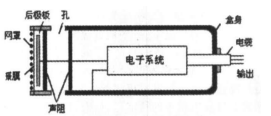
Condenser Microphone Structure Diagram
Due to the high structural plasticity of condenser microphones, they can be manufactured in various sizes. At the same time, condenser microphones have excellent performance, including low noise, wide frequency response, wide dynamic range, and variable directivity. Structurally, because the electric field distribution of the condenser microphone is uniform and the diaphragm is not uneven, the diaphragm can be tensioned close to its elastic limit, allowing faithful vibration and maintaining a large area. These factors determine the reproduction bandwidth and sensitivity of the transducer. In terms of frequency characteristics, low frequencies can be reproduced to near 0 Hz, and high frequencies can be reproduced flatly to the resonant frequency of the vibration system. Uniform and flat characteristics can be obtained across a wide frequency range.
Due to superior product performance, condenser microphones have captured a market share of far more than 50% in the current electroacoustic market. With the future widespread application of microelectronics, the market for condenser microphones is immeasurable.
However, condenser microphones also have limitations, such as requiring a stable current supply, high cost, high sensitivity, and susceptibility to feedback (howling). This is one of the reasons why condenser microphones have not yet completely replaced dynamic transducers.
Contact Information
No. 8 Gongye 4th Road, Encheng Sub-district, Enping City, Jiangmen City, Guangdong Province
Fax: +86-750-7187986







Online Message
Social Media


