

What are the differences between capacitive microphones and electret microphones?
2025-04-14
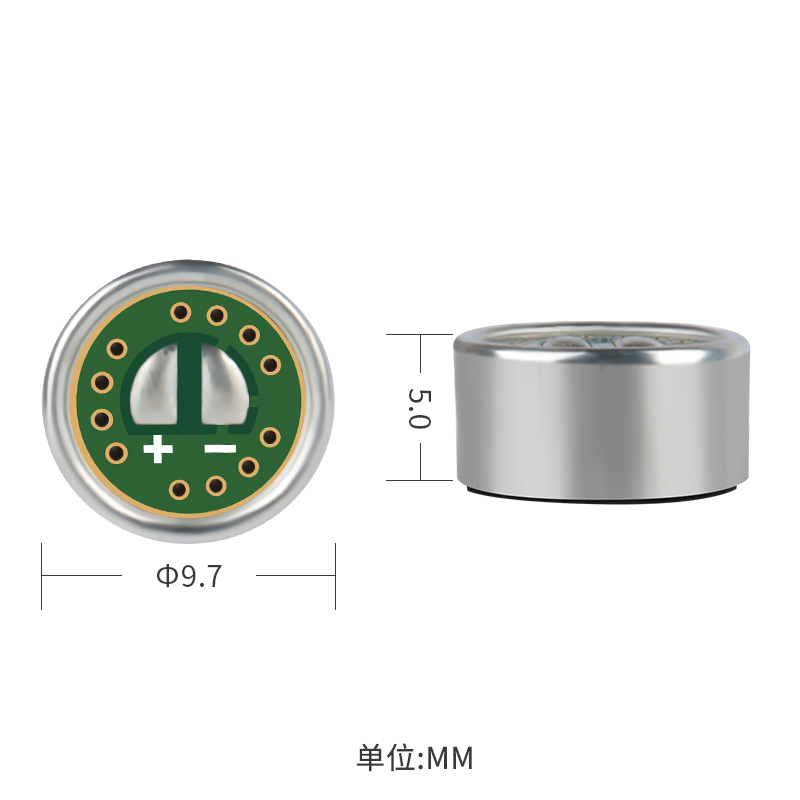
Generally, electret microphone capsules are also known as electret condenser microphone capsules and fall under the category of condenser microphones. One plate of the capacitor can sense changes in sound pressure, acting as a sound signal input. This plate is usually made of a metallized polymer diaphragm, forming a variable capacitor with the other plate, where the inter-electrode distance can change. When sound pressure is applied, the diaphragm vibrates, with the vibration intensity and frequency determined by the instantaneous sound pressure, and the capacitance changes accordingly with the sound signal.
If a constant voltage is applied to the capacitor, the change in capacitance will cause a change in the amount of charge polarized on the capacitor, thus producing an electrical signal across the capacitor, achieving sound-to-electrical signal conversion. The biggest difference from condenser microphones is that electret microphones do not require an external DC bias power supply; they can directly obtain DC bias by electretting the polymer diaphragm using certain electret materials (such as polytetrafluoroethylene and propylene).
In recent years, electret microphones have seen rapid development and increasingly widespread applications. This is mainly due to the unique properties of electret microphone materials. In electret dielectric materials, some are easily positively charged, while others are easily negatively charged. If, on the material that is most easily charged, a special electrical treatment method is used, it can be permanently charged with static electricity, which is equivalent to the bias voltage on a condenser microphone. The performance of electret microphones largely depends on the quality of the material itself.
A condenser microphone pickup unit has two electrodes, one of which is a vibrating metallized diaphragm, and the other is a metal plate. For electret condenser microphones, one electrode is made of or coated with electret material, using the electret material's ability to store charge to provide the constant voltage needed for normal operation. This eliminates the need for a power supply voltage to the microphone head, resulting in a simple structure and small size.
Depending on the location of the electret material, electret microphone capsules can be divided into diaphragm type and back-electrode type. Early electret microphones mostly used the diaphragm type, where the diaphragm is made of electret material; this has a relatively simple process and low technical requirements. However, since the sound quality of diaphragms made of electret material is not good, current electret microphones mostly use the back-electrode type, where electret material and polarized charges are attached to the other electrode (back electrode) of the capacitor. In addition, the diaphragm material of the back-electrode type microphone can also be selected from the perspective of sound pickup, allowing for the selection of materials with better sound quality.
From the perspective of current technological development, back-electrode type microphones are likely to be a trend for electret microphones.
Contact Information
No. 8 Gongye 4th Road, Encheng Sub-district, Enping City, Jiangmen City, Guangdong Province
Fax: +86-750-7187986







Online Message
Social Media


